



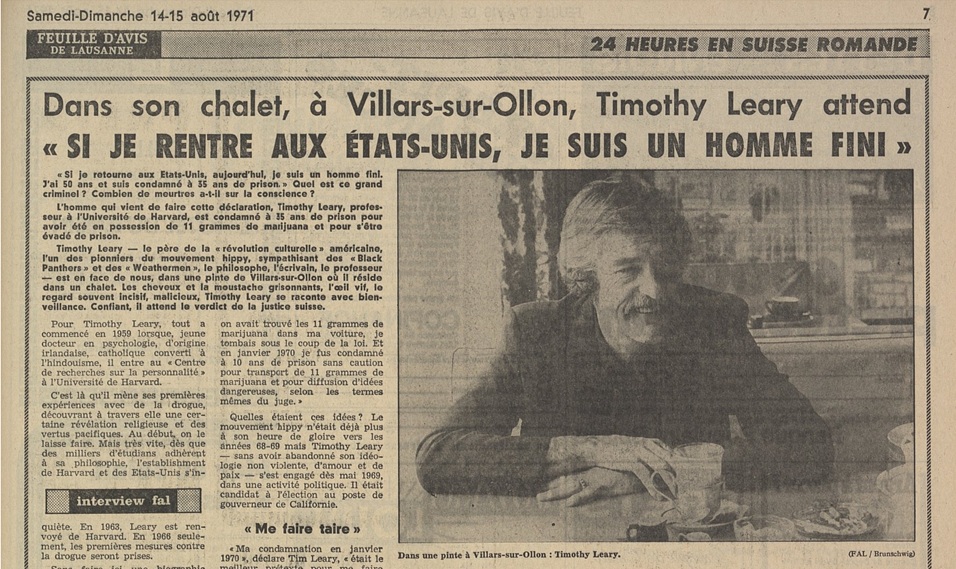
An apartment in the Domaine de la Résidence, a police raid at dawn and a case followed all the way to Washington: in 1971, Villars welcomed one of the most controversial figures of the American counterculture.
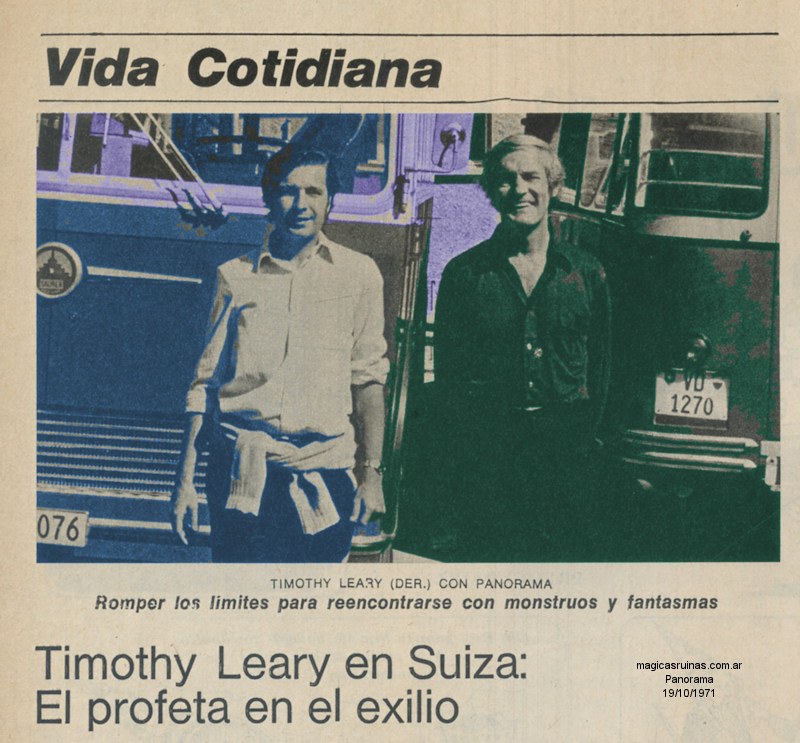
In Villars, celebrities come and go, but the memories stay. Timothy Leary’s belongs to an era when the resort could become, almost overnight, a stop on an international run from the law.
An American psychologist who taught at Harvard until 1963, Leary had become one of the faces of the psychedelic movement. His advocacy of LSD earned him the nickname “the pope of LSD”. Charismatic and provocative, he fascinated part of a generation as much as he worried the authorities. His academic work had itself drawn sharp criticism of its methods and rigour. Harvard looks back on this period of his career.
From California to the Vaud Alps
In September 1970, Leary escaped from a Californian prison where he was serving a sentence for marijuana possession. With his wife Rosemary, he first found refuge in Algeria with the exiled Black Panthers. But their situation deteriorated and, in spring 1971, the couple made their way to Switzerland. The story of their escape can be read in Sept (in French).
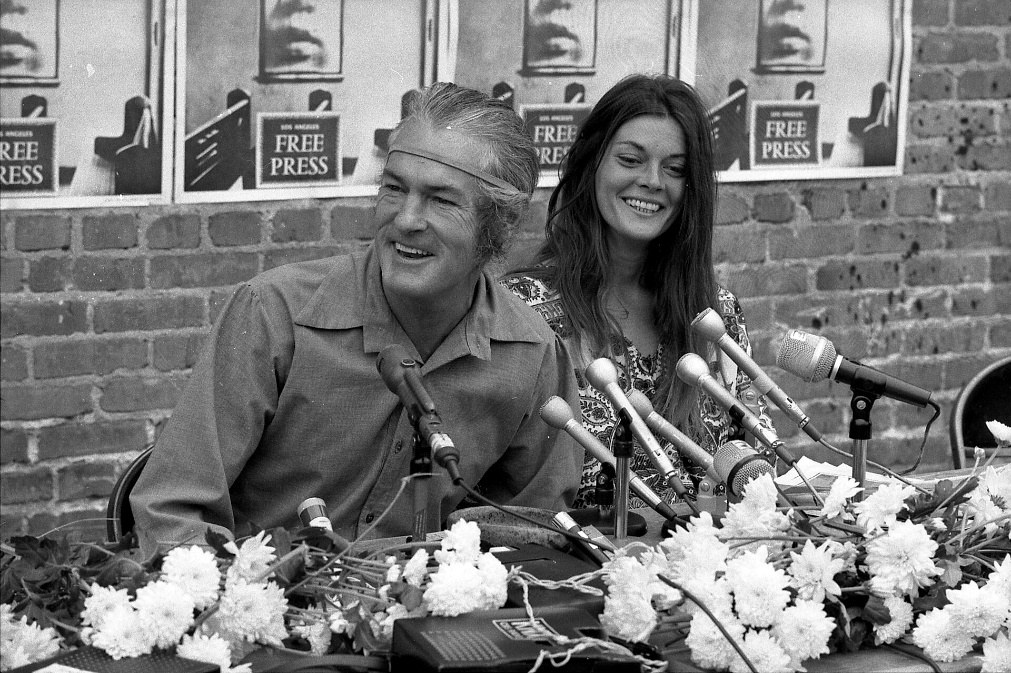
It was in Villars-sur-Ollon that they settled for part of their stay. Far from the bustle of California, Leary discovered the landscapes of the Vaud Alps. But the American authorities had not lost track of him.
At Gérance Service, his arrival left some very concrete memories. Huguette Seeholzer, who worked at the agency at the time, recalls:
“We rented him an apartment in the Dauphin building in the Domaine de la Résidence.”
Above all, she remembers a particularly eventful police operation. One morning at around six o’clock, she says, the Vaud police arrived to arrest Leary. The officers, however, apparently went to the wrong apartment, giving him time to get away.
This account is part of the local memories of his stay. Huguette also mentions a chalet in the Domaine de la Résidence that a friend or sympathiser is said to have lent him, though she cannot remember which one. The rented apartment and the chalet may therefore correspond to different moments of his time in the resort.
Who was the friend who lent him a chalet? The story doesn’t say. From 1972, the Domaine de la Résidence would also welcome another famous exile: Keith Richards. Villars’ chalets certainly have plenty of stories to tell…
→ Read our article on Keith Richards in Villars
An investigation that led to the archives in New York. To piece together this stay, we cross-checked local accounts and newspapers of the time, then contacted the New York Public Library, which holds Timothy Leary’s archives. A document listed as a photo album of Villars had caught our attention. After examining it, the archivist explained that it was in fact a notebook: a first entry is headed “Villars”, dated 23 September 1971, followed by reflections and quotations; a second, dated 30 October, also gathers quotations. The photographs on the following nine pages, however, were all taken in Zurich. Written traces of his time in Villars, but no new pictures of the resort!
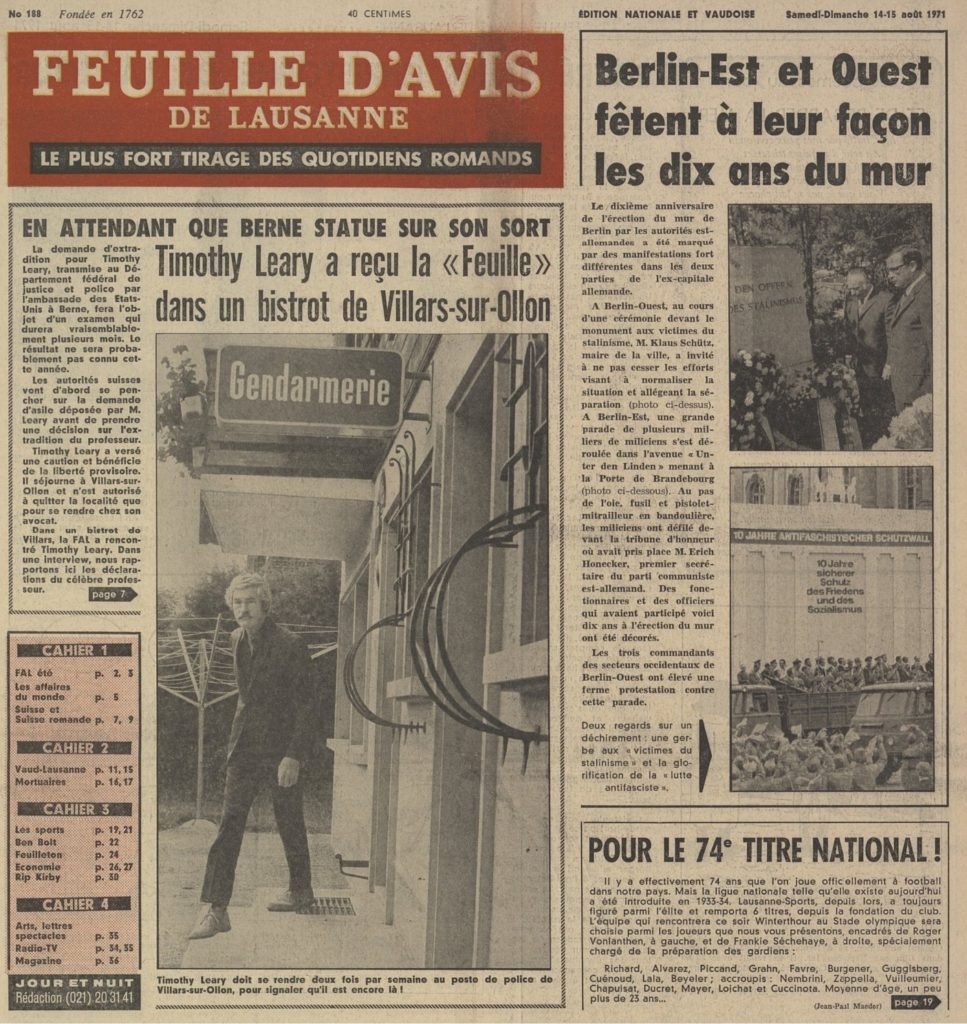
Villars on the front page
Leary’s arrest is documented at the end of June 1971. He was held in custody in Lausanne while the United States sought his extradition. Swiss artists and intellectuals rallied to his cause. The account of Lisbeth Vogt, published by Journal B, looks back on this period (in German).
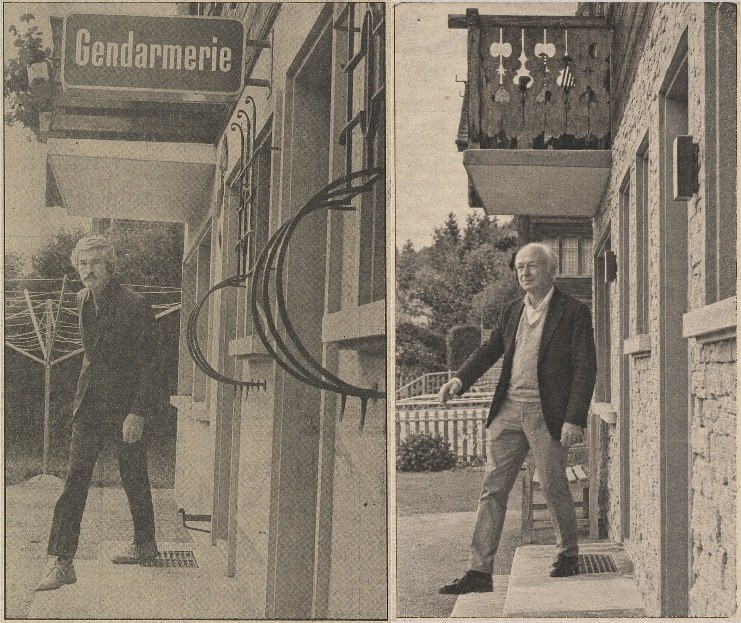
A few weeks later, he was granted provisional release. The Feuille d’avis de Lausanne devoted the front page of its Saturday–Sunday 14–15 August 1971 edition, issue 188, to him. He is pictured outside the gendarmerie; the caption explains that he had to report to the police station twice a week. His movements remained restricted while Bern examined his case. See the original front page on Scriptorium.
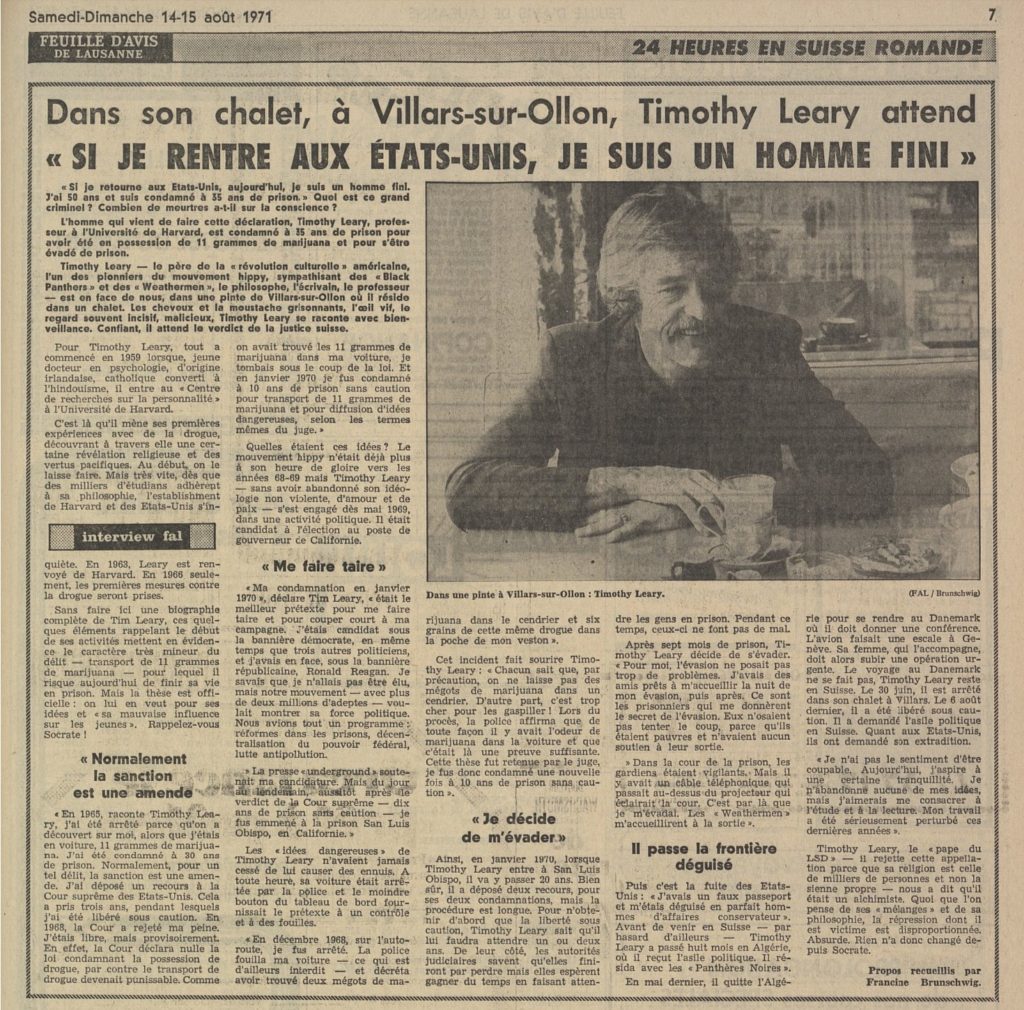
On page 7, another photograph shows him sitting at a table in his chalet. The headline of the interview sums up his fears:
“If I go back to the United States, I’m a finished man.”
The illustrated interview is available here (in French). In the viewer, printed page 7 corresponds to image 9.
Switzerland ultimately refused to extradite him, without granting him lasting asylum either.
A table at the Sporting
Another journalist came to meet Leary in Villars: Ovidio Lagos Rueda, for the Argentine magazine Panorama. In his report, published in October 1971, he describes Leary’s habits at the Sporting restaurant, including a table on the terrace from which he would gaze out over the valley and the mountains.
This account gives his exile an almost ordinary feel: meals at the restaurant, walks around the resort, chats with the regulars. The international fugitive was also a resident you might bump into in the streets of Villars. Read the original report (in Spanish).
A memorable encounter in Villars
For Diane de Beauvau-Craon, then a boarder at Beau Soleil, meeting Leary took on a very different meaning. The young aristocrat, at odds with the expectations of her background, would later say she found in him a rare understanding.
In the profile Harper’s Bazaar devoted to her, she sums up their bond:
“We were both escapees.”
Her path later led her to New York, alongside the fashion designer Halston and Andy Warhol. She recounted this life in Sans départir, published in 2022. Profile in Harper’s Bazaar, her memoir at Grasset (in French).
Leary, Lennon and the Beatles
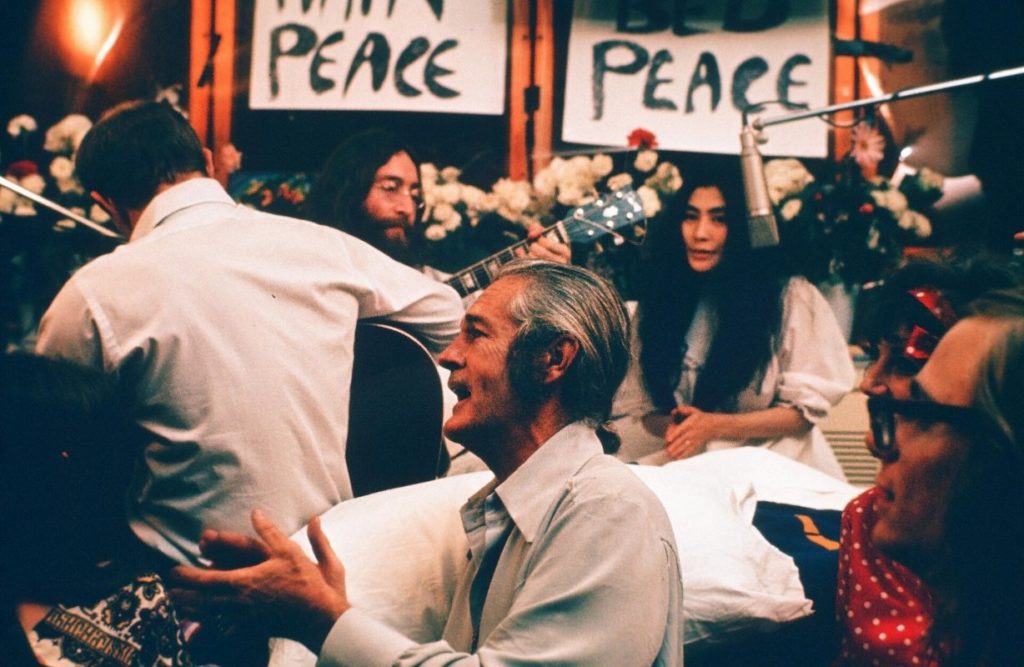
Leary’s influence had already reached popular music. In 1969, he asked John Lennon to write him a song for his political campaign. That request was the starting point for “Come Together”, which Lennon then turned into a Beatles track on the album Abbey Road. The band’s official website tells the story of this unexpected origin.
Leary left Switzerland in 1972. His flight took him as far as Afghanistan, where he was arrested in early 1973 before being returned to the United States. The Harry Ransom Center archives trace his journey.
What remains in Villars are the photographs, the press cuttings and the memories of those who crossed his path. Among them, Huguette Seeholzer’s is a reminder that a case followed in Washington could also begin with a rental in the Domaine de la Résidence – and a door the police knocked on by mistake.
With the testimony of Huguette Seeholzer, former employee of Gérance Service. Press archives: Feuille d’avis de Lausanne, 14–15 August 1971, no. 188, pages 1 and 7; Panorama, 19 October 1971.